
EasyOCR
easyocrJaidedAI EasyOCR. Simple Python OCR wrapper supporting 80+ languages with deep-learning text detection and recognition.
- Cena
- ≈ 0,0014 US$/spuštění
- Vstup → výstup
- Text + Obrázek → Text
- Vývojář
- Community
- Aktualizováno
- 23. září 2026
Playground
Vyzkoušet EasyOCR
Žádný formulář vstupu
Pro tento model zatím není formulář vstupu
Jeho vstupy nejsou zatím zdokumentovány. Aby se žádné spuštění neprovádělo s chybným vstupem, zde nenabízíme formulář. Místo toho si vyberte srovnatelný model.
Examples
 Input
InputNo text prompt: the model only takes the input shown.
Response
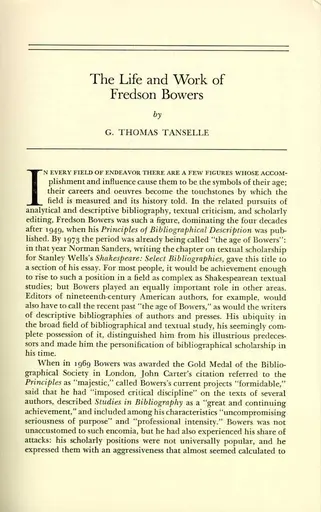
The Life and Work of Fredson Bowers by G. THOMAS TANSELLE N EVERY FIELD OF ENDEAVOR THERE ARE A FEW FIGURES WHOSE AGCOM- plishment and influence cause them to be the symbols of their age; their careers and oeuvres become the touchstones by which the field is measured and its history told. In the related pursuits of analytical and descriptive bibliography, textual criticism, and scholarly editing, Fredson Bowers was such a figure, dominating the four decades after 1949, when his Principles of Bibliographical Description was pub- lished. By 1973 the period was already being called “the age of Bowers”: in that year Norman Sanders, writing the chapter on textual scholarship for Stanley Wells's Shakespeare: Select Bibliographies, gave this title to a section of his essay. For most people, it would be achievement enough to rise to such a position in a field as complex as Shakespearean textual studies; but Bowers played an equally important role in other areas. Editors of nineteenth-century American authors, for example, would also have to call the recent past “the age of Bowers,” as would the writers of descriptive bibliographies of authors and presses. His ubiquity in the broad field of bibliographical and textual study, his seemingly com- plete possession of it, distinguished him from his illustrious predeces- sors and made him the personification of bibliographical scholarship in his time. When in 1969 Bowers was awarded the Gold Medal of the Biblio- graphical Society in Lo…
 Input
InputNo text prompt: the model only takes the input shown.
Response
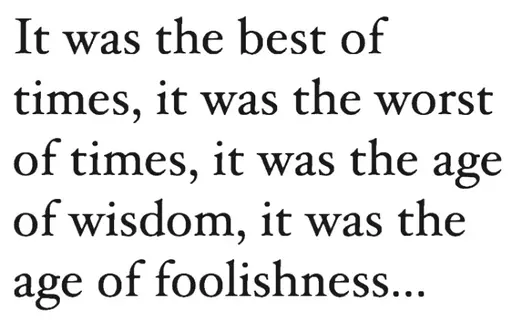
It was the best of times, it was the worst of times, it was the age of wisdom, it was the age of foolishness...
O EasyOCR
EasyOCR je model od Community v kategorii Multimodální. Na Railwail stojí EasyOCR ≈ 0,0014 US$ za spuštění.
Ceny
| Typické spuštění (≈ 11 s na CPU) | 0,0014 US$ za spuštění |
|---|---|
| GPU čas (CPU) | 0,00012 US$ za GPU sekundu |
- Účtuje se GPU čas, který spuštění skutečně trvá. Při spuštění je z vašeho zůstatku rezervováno 3× typická cena a později se vypořádá.
- 1 kredit = 0,01 US$
Kalkulátor nákladů
Kalkulátor cen
Typicky podle poskytovatele: přibližně 11 s
Celkem
0,14 US$
14 kreditů
Na spuštění
0,0014 US$ · 0,14 kreditů
Účtuje se skutečný čas GPU; jedná se o odhad.
API
Žádný ověřený příklad API
Veřejné API předává jiný formát vstupu, než tento model potřebuje. Použijte playground výše.
Specifikace
- ID modelu
easyocr- Vývojář
- Community
- Kategorie
- Multimodální
- Vstup
- Text, Obrázek
- Výstup
- Text
- Fakturace
- Podle použití (tokeny nebo GPU čas)
- Záznam v katalogu aktualizován
- 23. září 2026
Štítky
- replicate
- ocr
- vision-understanding
- multilingual
- open-source
Často kladené otázky
Co je EasyOCR?
EasyOCR je model od Community v kategorii Multimodální.
Kolik stojí EasyOCR na Railwail?
Na Railwail stojí EasyOCR ≈ 0,0014 US$ za spuštění. Platíte za to, co každý požadavek skutečně spotřebuje. Použití se platí z předplacených kreditů; 1 kredit se rovná 0,01 US$.
Jak rychlý je EasyOCR?
Pro EasyOCR je na Railwail zatím příliš málo naměřených spuštění na uvedení doby běhu. Závisí na vstupu, nastavení a zátěži u poskytovatele.
Je EasyOCR lepší než BLIP?
Záleží na úkolu. EasyOCR (Community) a BLIP (Salesforce) jsou oba modely v kategorii Multimodální. Stránka porovnání zobrazuje jejich ceny a specifikace vedle sebe.
Porovnat EasyOCR a BLIPMůže EasyOCR zpracovávat obrázky?
Ano. EasyOCR přijímá obrázky jako vstup kromě textu.
Srovnatelné modely
Všechny v této kategorii- BLIPSalesforce
Salesforce BLIP. Vision-language model for image captioning and visual question answering. Given an image it writes a short natural-language caption, or answers a question about the image when one is supplied. A widely used baseline for automatic captioning.
- CLIP InterrogatorCommunity
pharmapsychotic's CLIP Interrogator. Takes an image and produces a Stable-Diffusion-style text prompt by combining BLIP captioning with CLIP to rank likely subjects, artists, mediums and styles. Commonly used to reverse-engineer a prompt from an existing picture.
- Depth Anything v2Community
Monocular depth-estimation model trained on 595k labeled and 62M unlabeled images. Strong zero-shot generalization in indoor and outdoor scenes.
Všechny modely přes jednu API
Jeden API klíč pro všechny modely na Railwail. Použití se účtuje z předplacených kreditů, 1 kredit = 0,01 US$.