
EasyOCR
easyocrJaidedAI EasyOCR. Simple Python OCR wrapper supporting 80+ languages with deep-learning text detection and recognition.
- Prix
- ≈ 0,0014 $US/exécution
- Entrée → Sortie
- Texte + Image → Texte
- Développeur
- Community
- Mis à jour
- 23 septembre 2026
Playground
Essayer EasyOCR
Pas de formulaire d'entrée
Aucun formulaire d'entrée pour ce modèle pour le moment
Ses entrées ne sont pas encore documentées. Pour éviter qu'une exécution échoue sur une entrée incorrecte, nous ne proposons pas de formulaire ici. Choisissez plutôt un modèle comparable.
Examples
 Input
InputNo text prompt: the model only takes the input shown.
Response
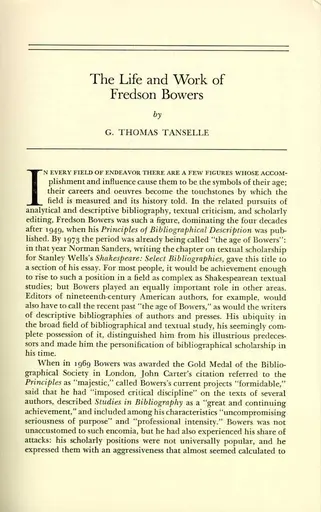
The Life and Work of Fredson Bowers by G. THOMAS TANSELLE N EVERY FIELD OF ENDEAVOR THERE ARE A FEW FIGURES WHOSE AGCOM- plishment and influence cause them to be the symbols of their age; their careers and oeuvres become the touchstones by which the field is measured and its history told. In the related pursuits of analytical and descriptive bibliography, textual criticism, and scholarly editing, Fredson Bowers was such a figure, dominating the four decades after 1949, when his Principles of Bibliographical Description was pub- lished. By 1973 the period was already being called “the age of Bowers”: in that year Norman Sanders, writing the chapter on textual scholarship for Stanley Wells's Shakespeare: Select Bibliographies, gave this title to a section of his essay. For most people, it would be achievement enough to rise to such a position in a field as complex as Shakespearean textual studies; but Bowers played an equally important role in other areas. Editors of nineteenth-century American authors, for example, would also have to call the recent past “the age of Bowers,” as would the writers of descriptive bibliographies of authors and presses. His ubiquity in the broad field of bibliographical and textual study, his seemingly com- plete possession of it, distinguished him from his illustrious predeces- sors and made him the personification of bibliographical scholarship in his time. When in 1969 Bowers was awarded the Gold Medal of the Biblio- graphical Society in Lo…
 Input
InputNo text prompt: the model only takes the input shown.
Response
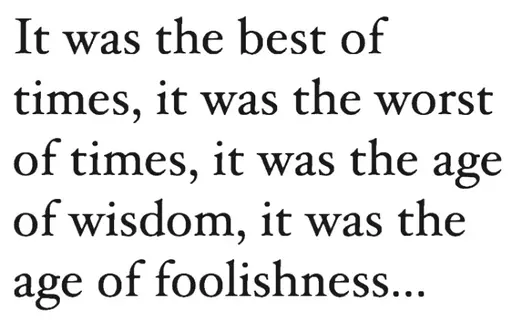
It was the best of times, it was the worst of times, it was the age of wisdom, it was the age of foolishness...
À propos de EasyOCR
EasyOCR est un modèle de Community dans la catégorie Multimodal. Sur Railwail, EasyOCR coûte ≈ 0,0014 $US par exécution.
Tarification
| Exécution typique (≈ 11 s sur CPU) | 0,0014 $US par exécution |
|---|---|
| Temps GPU (CPU) | 0,00012 $US par seconde GPU |
- Facturé selon le temps GPU réellement utilisé. Au démarrage, 3× le prix typique est réservé sur votre solde et régularisé ensuite.
- 1 crédit = 0,01 $US
Calculateur de coûts
Calculateur de prix
Typique selon le fournisseur : environ 11 s
Total
0,14 $US
14 crédits
Par exécution
0,0014 $US · 0,14 crédits
Facturé selon le temps GPU réel ; ceci est une estimation.
API
Aucun exemple API vérifié
L'API publique transmet un format d'entrée différent de celui dont ce modèle a besoin. Utilisez le playground ci-dessus.
Spécifications
- ID du modèle
easyocr- Développeur
- Community
- Catégorie
- Multimodal
- Entrée
- Texte, Image
- Sortie
- Texte
- Facturation
- À l'usage (tokens ou temps GPU)
- Entrée du catalogue mise à jour
- 23 septembre 2026
Étiquettes
- replicate
- ocr
- vision-understanding
- multilingual
- open-source
Questions fréquemment posées
Qu'est-ce que EasyOCR ?
EasyOCR est un modèle de Community dans la catégorie Multimodal.
Combien coûte EasyOCR sur Railwail ?
Sur Railwail, EasyOCR coûte ≈ 0,0014 $US par exécution. Vous êtes facturé pour ce que chaque requête utilise réellement. L'utilisation est payée à partir de crédits prépayés ; 1 crédit équivaut à 0,01 $US.
Quelle est la vitesse de EasyOCR ?
Il n'y a pas encore assez d'exécutions mesurées de EasyOCR sur Railwail pour indiquer un temps d'exécution. Cela dépend de l'entrée, des paramètres et de la charge chez le fournisseur.
EasyOCR est-il meilleur que BLIP ?
Cela dépend de la tâche. EasyOCR (Community) et BLIP (Salesforce) sont tous deux des modèles de la catégorie Multimodal. La page de comparaison affiche leurs prix et spécifications côte à côte.
Comparer EasyOCR et BLIPEasyOCR peut-il traiter des images ?
Oui. EasyOCR accepte les images en entrée en plus du texte.
Modèles comparables
Tous dans cette catégorie- BLIPSalesforce
Salesforce BLIP. Vision-language model for image captioning and visual question answering. Given an image it writes a short natural-language caption, or answers a question about the image when one is supplied. A widely used baseline for automatic captioning.
- CLIP InterrogatorCommunity
pharmapsychotic's CLIP Interrogator. Takes an image and produces a Stable-Diffusion-style text prompt by combining BLIP captioning with CLIP to rank likely subjects, artists, mediums and styles. Commonly used to reverse-engineer a prompt from an existing picture.
- Depth Anything v2Community
Monocular depth-estimation model trained on 595k labeled and 62M unlabeled images. Strong zero-shot generalization in indoor and outdoor scenes.
Tous les modèles via une seule API
Une clé API pour tous les modèles sur Railwail. L'utilisation est facturée à partir de crédits prépayés, 1 crédit = 0,01 $US.