
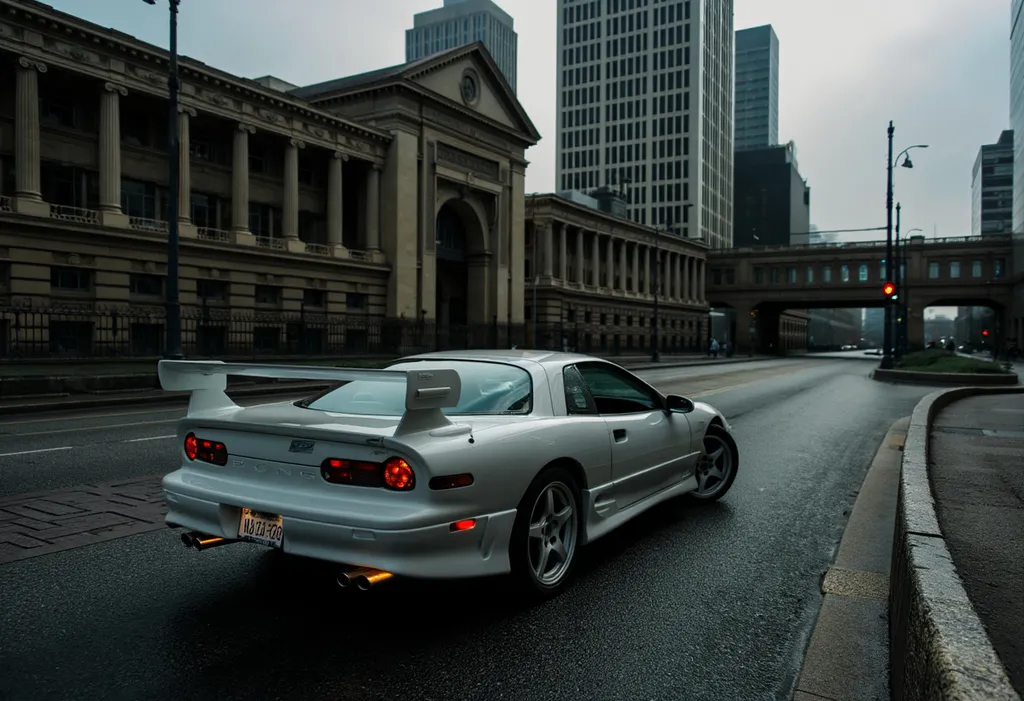



FLUX.1 Canny

Image generationAvailable
by Black Forest LabsModel ID: flux-1-canny

FLUX structural control via Canny edge maps. Preserve composition while restyling.

Price
$0.060/image
Input โ†’ output
Text โ†’ Image
Developer
Black Forest Labs
Updated
September 23, 2026
01

Playground

Try FLUX.1 Canny

No input form

$0.060/image

No input form for this model yet

Its inputs are not documented yet. So that no run fails on a wrong input, we don't offer a form here. Pick a comparable model instead.

02

Examples

Real outputs from the public examples of this model on Replicate, with the prompt and settings that produced them. They were not generated live on this page.
03

About FLUX.1 Canny

TL;DRAs of September 23, 2026

FLUX.1 Canny is a model by Black Forest Labs in the Image generation category. On Railwail, FLUX.1 Canny costs $0.060 per image.

Background

About Black Forest Labs

Founded 2024 ยท Freiburg, Germany

Black Forest Labs was founded in August 2024 in Freiburg, Germany by Robin Rombach, Patrick Esser, Andreas Blattmann and Dominik Lorenz, the core team that previously developed Latent Diffusion Models (LDM) and Stable Diffusion at LMU Munich and Stability AI. The team's earlier work includes the seminal 'High-Resolution Image Synthesis with Latent Diffusion Models' (CVPR 2022) and the Stable Diffusion 1.x/2.x and SDXL releases. The company raised a $31M seed round led by Andreessen Horowitz in 2024 and launched the FLUX.1 model family (pro, dev, schnell) along with specialist Tools models (Fill, Canny, Depth, Redux). Their stated goal is to be the leading open foundation-model lab for generative media in Europe.

Visit Black Forest Labs

Architecture

Rectified-flow Transformer (DiT) with Canny-edge structural conditioning

FLUX.1 Canny is part of the FLUX.1 Tools family released by Black Forest Labs in late 2024. It extends the base FLUX.1 [dev] / [pro] rectified-flow transformer (a Diffusion Transformer trained with the flow-matching objective rather than classical DDPM) with a structural conditioning branch that ingests a Canny edge map of a reference image. The conditioning is implemented as a ControlNet-like adapter that injects edge features into the DiT blocks via cross-attention residuals, so that the output respects the line structure of the input while the prompt controls semantics, style and lighting. The backbone uses T5-XXL plus CLIP-L as text encoders and operates in a learned latent space at 16x downsampling. Sampling typically uses 28-50 flow-matching steps with the Euler or DPM-Solver sampler. The model was distilled and fine-tuned on edge-conditioned pairs derived from a large licensed image corpus.

Parameters
~12B (FLUX.1 dev backbone) plus ControlNet-style conditioning
Context
512 tokens

Capabilities

  • Edge-conditioned image generation that preserves line structure of a reference
  • Works at up to 2 MP output resolution
  • Strong photorealism inherited from FLUX.1 [dev]/[pro]
  • Excellent prompt adherence via T5-XXL text encoder
  • Useful for redesigns, restyles and product re-skins on a fixed silhouette
  • Compatible with the rest of the FLUX Tools family (Fill, Depth, Redux)
  • Best for: e-commerce restyling, architectural restyling, fashion mockups, design iteration.

Training & license

Fine-tuned from FLUX.1 base weights on pairs of images with extracted Canny edge maps. Exact dataset is not disclosed; Black Forest Labs states licensed and curated data.

License: FLUX.1 [dev] non-commercial license for the dev weights; FLUX.1 [pro] available only via API. Commercial use requires the pro/enterprise tier.

Safety testing: Standard Black Forest Labs safety filters; the model inherits guardrails of the base FLUX.1 family including filters for CSAM, non-consensual intimate imagery and IP-protected content.

Known limitations

  • Requires a precomputed Canny edge map as input
  • Quality of output is strongly dependent on the source edges
  • Dev weights are non-commercial only
  • Slower than schnell-tier base model
04

Pricing

Prices in US dollars. Usage is charged from prepaid credits.
Per image$0.060 per image
  • 1 credit = $0.01

Cost calculator

Price calculator

Total

$6.00

600 credits

Per run

$0.06 ยท 6 credits

Fixed price per run, known before the run starts.

05

API

Call FLUX.1 Canny with your Railwail API key. Use this model ID in the request:

No verified API example

The inputs of this model are not documented yet.

06

Specifications

Model ID
flux-1-canny
Input
Text
Output
Image
Billing
Fixed price, known before the run
Model size
~12B (FLUX.1 dev backbone) plus ControlNet-style conditioning
License
FLUX.1 [dev] non-commercial license for the dev weights; FLUX.1 [pro] available only via API. Commercial use requires the pro/enterprise tier.
Catalog entry updated
September 23, 2026

Tags

  • flux
  • black-forest-labs
  • image-edit
  • controlnet
  • canny
  • structural
07

Use cases

What it is used for

  • E-commerce product restyling on fixed silhouettes
  • Architectural facade restyling
  • Fashion try-on and material swap
  • Logo-to-render exploration
  • Coloring-book-style controlled generation
  • Storyboard line-to-render conversion
08

Frequently asked questions

What is FLUX.1 Canny?

FLUX.1 Canny is a model by Black Forest Labs in the Image generation category.

How much does FLUX.1 Canny cost on Railwail?

On Railwail, FLUX.1 Canny costs $0.060 per image. The price is known before the run starts. Usage is paid from prepaid credits; 1 credit equals $0.01.

How fast is FLUX.1 Canny?

There are not enough measured runs of FLUX.1 Canny on Railwail yet to state a run time. It depends on the input, the settings and the load at the provider.

Is FLUX.1 Canny better than FLUX 1.1 Pro?

That depends on the task. FLUX.1 Canny (Black Forest Labs) and FLUX 1.1 Pro (Black Forest Labs) are both models in the Image generation category. The comparison page shows their prices and specifications side by side.

Compare FLUX.1 Canny and FLUX 1.1 Pro
09

Comparable models

All in this category

All models through one API

One API key for every model on Railwail. Usage is charged from prepaid credits, 1 credit = $0.01.