
EasyOCR
easyocrJaidedAI EasyOCR. Simple Python OCR wrapper supporting 80+ languages with deep-learning text detection and recognition.
- Precio
- ≈ 0,0014 US$/ejecución
- Entrada → Salida
- Texto + Imagen → Texto
- Desarrollador
- Community
- Actualizado
- 23 de septiembre de 2026
Playground
Probar EasyOCR
Sin formulario de entrada
Aún no hay formulario de entrada para este modelo
Sus entradas aún no están documentadas. Para que ninguna ejecución falle por una entrada incorrecta, no ofrecemos un formulario aquí. Elige un modelo comparable en su lugar.
Examples
 Input
InputNo text prompt: the model only takes the input shown.
Response
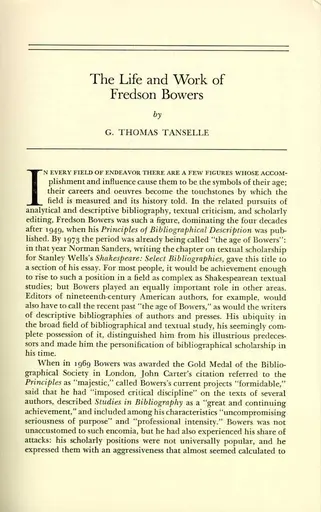
The Life and Work of Fredson Bowers by G. THOMAS TANSELLE N EVERY FIELD OF ENDEAVOR THERE ARE A FEW FIGURES WHOSE AGCOM- plishment and influence cause them to be the symbols of their age; their careers and oeuvres become the touchstones by which the field is measured and its history told. In the related pursuits of analytical and descriptive bibliography, textual criticism, and scholarly editing, Fredson Bowers was such a figure, dominating the four decades after 1949, when his Principles of Bibliographical Description was pub- lished. By 1973 the period was already being called “the age of Bowers”: in that year Norman Sanders, writing the chapter on textual scholarship for Stanley Wells's Shakespeare: Select Bibliographies, gave this title to a section of his essay. For most people, it would be achievement enough to rise to such a position in a field as complex as Shakespearean textual studies; but Bowers played an equally important role in other areas. Editors of nineteenth-century American authors, for example, would also have to call the recent past “the age of Bowers,” as would the writers of descriptive bibliographies of authors and presses. His ubiquity in the broad field of bibliographical and textual study, his seemingly com- plete possession of it, distinguished him from his illustrious predeces- sors and made him the personification of bibliographical scholarship in his time. When in 1969 Bowers was awarded the Gold Medal of the Biblio- graphical Society in Lo…
 Input
InputNo text prompt: the model only takes the input shown.
Response
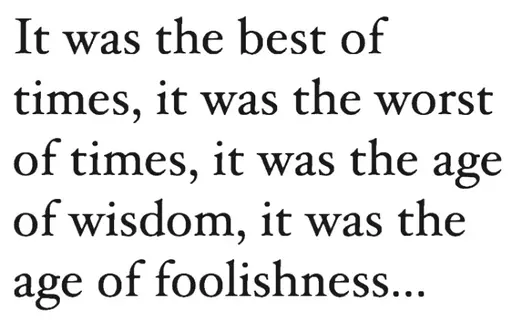
It was the best of times, it was the worst of times, it was the age of wisdom, it was the age of foolishness...
Acerca de EasyOCR
EasyOCR es un modelo de Community en la categoría Multimodal. En Railwail, EasyOCR cuesta ≈ 0,0014 US$ por ejecución.
Precios
| Ejecución típica (≈ 11 s en CPU) | 0,0014 US$ por ejecución |
|---|---|
| Tiempo de GPU (CPU) | 0,00012 US$ por segundo de GPU |
- Se factura por el tiempo de GPU que realmente tarda la ejecución. Cuando comienza la ejecución, se reserva 3× el precio típico de tu saldo y se liquida después.
- 1 crédito = 0,01 US$
Calculadora de costes
Calculadora de precios
Típico según el proveedor: aprox. 11 s
Total
0,14 US$
14 créditos
Por ejecución
0,0014 US$ · 0,14 créditos
Se factura el tiempo real de GPU; este es un estimado.
API
Sin ejemplo de API verificado
La API pública pasa un formato de entrada diferente al que necesita este modelo. Usa el playground anterior.
Especificaciones
- ID del modelo
easyocr- Desarrollador
- Community
- Categoría
- Multimodal
- Entrada
- Texto, Imagen
- Salida
- Texto
- Facturación
- Por uso (tokens o tiempo de GPU)
- Entrada del catálogo actualizada
- 23 de septiembre de 2026
Etiquetas
- replicate
- ocr
- vision-understanding
- multilingual
- open-source
Preguntas frecuentes
¿Qué es EasyOCR?
EasyOCR es un modelo de Community en la categoría Multimodal.
¿Cuánto cuesta EasyOCR en Railwail?
En Railwail, EasyOCR cuesta ≈ 0,0014 US$ por ejecución. Se te cobra por lo que cada solicitud realmente consume. El uso se paga con créditos prepagados; 1 crédito equivale a 0,01 US$.
¿Qué velocidad tiene EasyOCR?
Aún no hay suficientes ejecuciones medidas de EasyOCR en Railwail para indicar un tiempo de ejecución. Depende de la entrada, la configuración y la carga en el proveedor.
¿Es EasyOCR mejor que BLIP?
Depende de la tarea. EasyOCR (Community) y BLIP (Salesforce) son ambos modelos en la categoría Multimodal. La página de comparación muestra sus precios y especificaciones lado a lado.
Comparar EasyOCR y BLIP¿Puede EasyOCR procesar imágenes?
Sí. EasyOCR acepta imágenes como entrada además de texto.
Modelos comparables
Todos en esta categoría- BLIPSalesforce
Salesforce BLIP. Vision-language model for image captioning and visual question answering. Given an image it writes a short natural-language caption, or answers a question about the image when one is supplied. A widely used baseline for automatic captioning.
- CLIP InterrogatorCommunity
pharmapsychotic's CLIP Interrogator. Takes an image and produces a Stable-Diffusion-style text prompt by combining BLIP captioning with CLIP to rank likely subjects, artists, mediums and styles. Commonly used to reverse-engineer a prompt from an existing picture.
- Depth Anything v2Community
Monocular depth-estimation model trained on 595k labeled and 62M unlabeled images. Strong zero-shot generalization in indoor and outdoor scenes.
Todos los modelos a través de una API
Una clave API para todos los modelos en Railwail. El uso se cobra desde créditos prepagados, 1 crédito = 0,01 US$.